
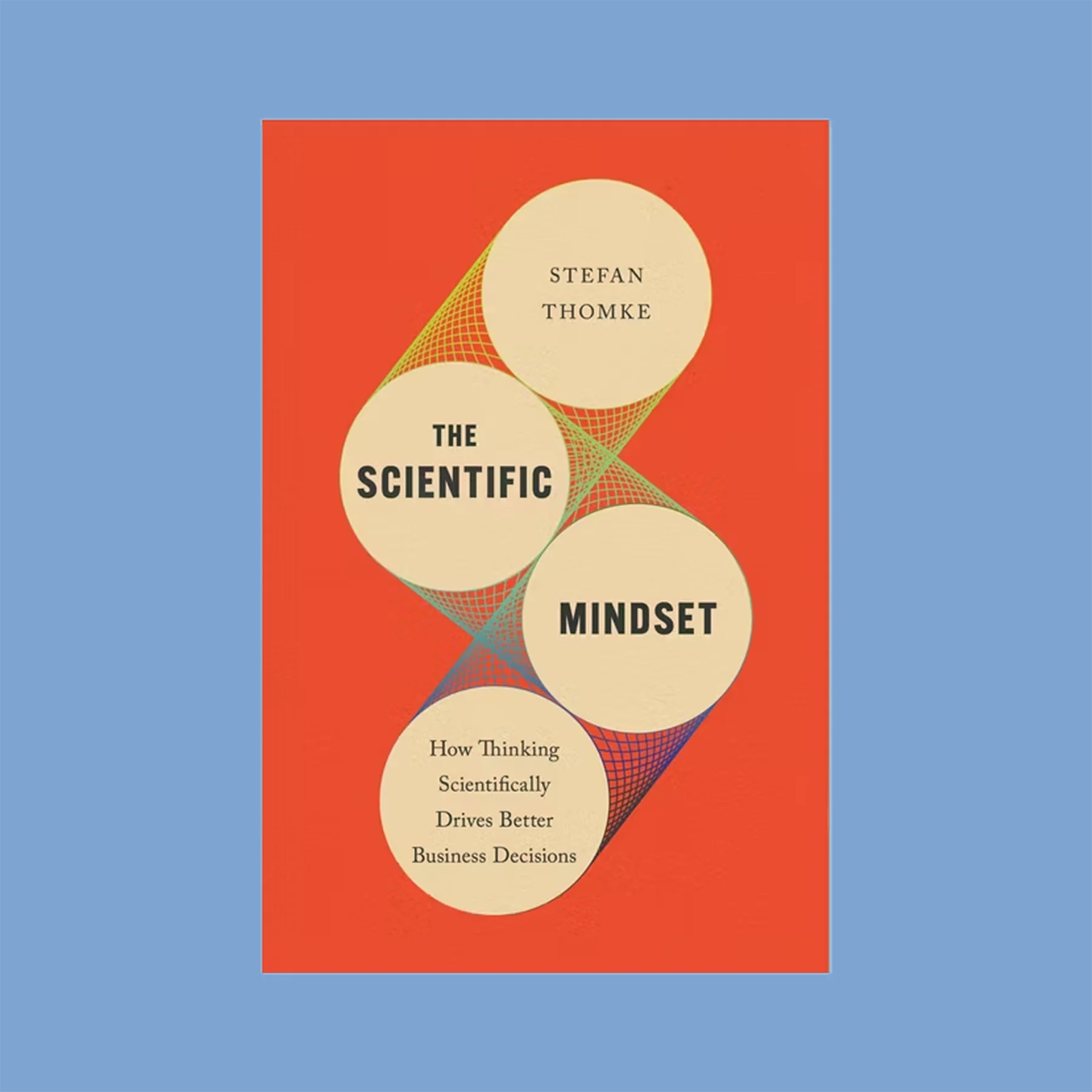
This is an excerpt from the book The Scientific Mindset: How Thinking Scientifically Drives Better Business Decisions by Stefan Thomke. Harvard Business Review Press, November 2026.
Every day, leaders make decisions about products, customers, resource allocation, and more, basing them on causal assumptions that have rarely, if ever, been critically examined. These decisions are consequential when they commit organizations to difficult-to-reverse actions.
A CEO may, for example, replace a business unit manager with a star performer lured from a competitor, assuming that this will lead to better financial results. (Actually, research has shown that it may not.) “I’ve always been successful doing it this way” is what we often hear when people are asked why they didn’t question practices that turned out to be faulty or refused to try something new. Or they may insist that “this idea will never work” because of a failed attempt that embarrassed or frustrated them in the past.
Leaders recognize the value of thinking scientifically when experiments show that the ideas behind such practice are flawed or outdated.
Leaders recognize the value of thinking scientifically when experiments show that the ideas behind such practice are flawed or outdated. When we think scientifically, we recognize that human beings make errors in cognition and judgment and can drift into complacency built on flawed assumptions. When we act scientifically, we become open to new ideas, relentlessly question our assumptions, and change them if experiments show they’re wrong.
To do so requires an experimentation culture, which makes a scientific mindset integral to everyday organizational life. And that means: nurturing curiosity, empowering anyone (not just R&D) to conduct or commission tests, following test results where they lead, and being clear on ethical needs.
But if most decisions are made this way, is there anything left for business leaders to do beyond developing the company’s strategic direction and tackling big decisions, such as which acquisitions to make? I suggest that there are at least four things that leaders can do to create and nurture a culture that thinks and acts scientifically:
Set a grand challenge that can be broken into testable hypotheses and key performance metrics. Employees need to see how their experiments support an overall strategic goal. Say, for instance, senior leaders of an e-commerce platform challenge employees to design the best customer experience in the industry. The leaders might expect that a superior experience will generate more customer traffic, which would attract more suppliers to the company’s platform, helping expand the customer base and activity even more. To discover ways to pursue that goal, employees could devise hypotheses and related metrics; for instance, that underlining important text could increase conversion rates by making critical information easier to find, and that a “one click, no cost” order cancellation option could boost user return rates without causing net sales to drop.
Establish systems, resources, and organizational designs that allow for large-scale experimentation. Scientifically testing nearly every idea requires infrastructure: instrumentation, data pipelines, and data scientists. Third-party tools and services can make it easy to try experiments, but to scale things up, senior leaders must tightly integrate the testing capability into company processes. Doing so requires striking the right balance between centralization and decentralization. In centralized groups, dedicated specialists can run experiments for the entire company and focus on introducing state-of-the-art methods and tools. But if testing is limited to a small group of specialists, it will be hard to scale up experimentation and change the company’s larger culture. In decentralized testing, firms spread specialist teams throughout different business units and thereby influence the firm’s overall culture.
Scientifically testing nearly every idea requires infrastructure: instrumentation, data pipelines, and data scientists.
While the latter approach expands experimentation to more parts of the organization, it can hinder knowledge sharing and lead to conflicting goals and poor coordination among specialists. Decentralization may be needed to get the broader organization involved at first, but after that, firms should turn to improving their experimentation capabilities. That’s what Booking.com did. It initially used satellite teams to spread experimentation across the company but found that they were too busy supporting users to focus on building firmwide capabilities.
Finally, in a center of excellence model, some specialists stay in a centralized function and others within the different business units. This framework can spread best testing practices and make an experimentation platform and related tools available companywide. The main disadvantages are a lack of clarity about what the center of excellence and product teams own and who should pay for hiring more specialists.
Booking later switched to the center of excellence model that supported business units, standardized the company’s approach to experimentation, and made sure that best practices were adopted and followed.
Be a role model. Business leaders have to live by the same rules as everyone else and subject their own ideas to tests. “You can’t have an ego, thinking that you always know best,” Gillian Tans, Booking.com’s former CEO, told me. “If I, as the CEO, say to someone, ‘This is what I want you to do because I think it’s good for our business,’ employees would literally look at me and say, ‘OK, that’s fine, we are going to test it and see if you are right.’”
This is what happened to Booking’s previous CEO, who presented the company’s redesigned logo to the staff after arriving at the company. Instead of accepting his decision, they responded, “That’s great, we’ll check it with an experiment.” The new CEO was baffled but had no choice but to agree to the test. Bosses ought to display intellectual humility and be unafraid to admit, “I don’t know.”
Recognize that words alone won’t change behavior. Ultimately, being a leader in an experiment-driven organization means letting go and empowering employees to perform their own tests, which doesn’t happen by simply telling people they can do so. It requires a concerted effort like IBM’s.
In 2015, experimentation wasn’t a core activity; the company’s IT function offered to run tests, but they were costly, were charged back to business units, and had to follow a rigid process. The testing capacity consisted of just one specialist, who was also the gatekeeper who rejected many proposed experiments because he felt that they weren’t strong-enough candidates. As a result, the company ran only 97 tests that year.
Then IBM’s head of marketing analytics took over experimentation. With the backing of the chief marketing officer, he empowered over 5,500 marketers worldwide to conduct their own tests. To induce them to do it, he took a number of steps: He installed easy-to-use tools, created a center of excellence to provide support, introduced a framework for conducting disciplined experiments, offered training for everyone, and made online tests free for all business groups. He also conducted an initial “testing blitz” during which the marketing units had to run a total of 30 online experiments in 30 days.
After that, he held quarterly contests for the most innovative or most scalable experiments. He also employed more forceful tactics: IBM tied part of marketing units’ budgets to experimentation plans. These efforts worked. After three years, the number of annual tests had surged to 2,822.
Reprinted by permission of Harvard Business Review Press. Excerpted from The Scientific Mindset: How Thinking Scientifically Drives Better Business Decisions by Stefan Thomke. Copyright 2027 Stefan Thomke. All rights reserved.
