
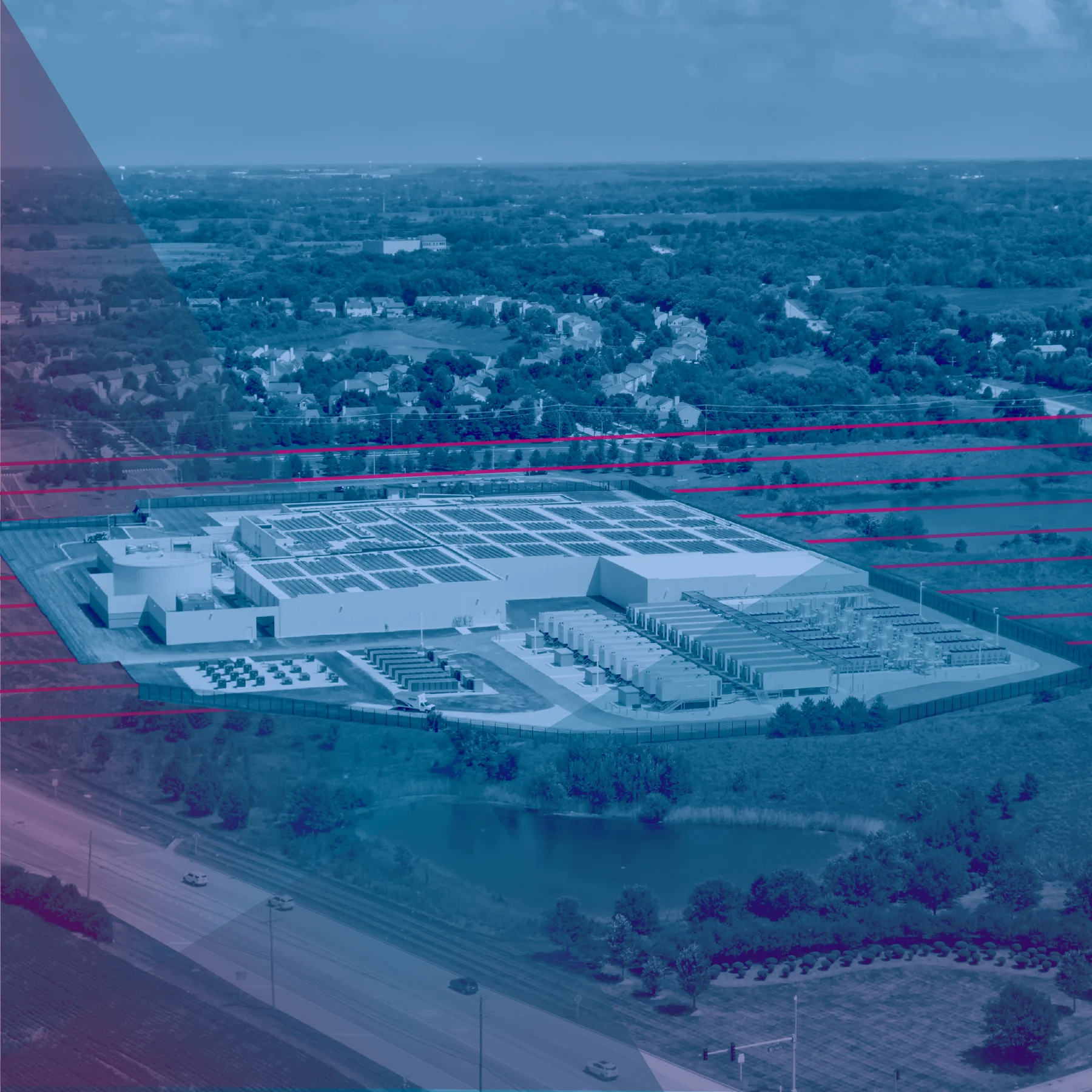
Many Americans blame rising electricity prices on Big Tech’s resource-hogging data centers, but Amazon, Google, Meta, and Microsoft aren’t really the problem.
It’s true that data centers lifted costs for residents between 2020 and 2025, but inflation, rising fuel expenses, and grid upgrades drove almost all of that increase. Only 4% of residents’ price hikes during that time can be attributed to data center demand, says research by Harvard Business Assistant Professor Christian Kaps.
Data centers, particularly those powering the artificial intelligence boom, have become a lightning rod for US residents reeling from years of post-pandemic inflation. Civic leaders in many American towns and states have been weighing calls for moratoriums against the risks of missing out on what might be a once-in-a-generation economic opportunity.
However, not all data centers contribute to higher electricity prices for consumers, says the working paper, “The Cost of Intelligence: Impacts of AI Data Centers on US Electricity Prices.” Kaps coauthored the October paper with Vishrut Rana, a doctoral candidate at the University of Pennsylvania’s Wharton School, and Serguei Netessine, a Wharton professor.
Their analysis finds that a data center’s owner and conditions at host utilities influence who bears the cost and how much, with industrial customers facing rising costs first.
“It’s crucially important for the public discourse to understand that it’s not the data center, per se,” says Kaps. “It’s how you manage the data center in respect to the utility and other grid providers.”
Who pays for data center demand?
Global electricity consumption by data centers is expected to double by 2030, according to the International Energy Agency, as companies rush to scale up their computing power. By that year, data centers could consume as much as 15% of electricity in the US alone, projects the Lawrence Berkeley National Laboratory.
Who will ultimately help pay to build the utility infrastructure needed to power the centers through higher prices? It depends.
Kaps and his colleagues analyzed the owners, locations, and power needs of 385 data centers between 2020 and 2025, using data from Aterio, an energy research company. They used cost and customer information collected by the US government for the 42 utilities serving them.
After separating centers owned by Amazon, Google, Meta, and Microsoft from third-party operators that store information for other businesses, the researchers found that:
Overall, data centers contributed almost 16% of the total price increase for industrial customers, and 4% for residential customers during that time.
For the average utility studied, data center capacity additions boosted prices by $5.40 per megawatt-hour for industrial customers and $1.70 for residents.
While “colocated” centers that lease storage to business clients have raised consumer electricity costs, centers built by the “Big Four” tech companies have not.
Utilities already built to efficiently serve high-demand industrial customers at scale were less likely to pass on costs to residential customers.
“Our findings suggest that the prevailing discourse about data centers affecting electricity affordability is overstated,” the authors write.
Although nominal electricity prices have risen since 2020, inflation-adjusted prices have remained flat or, in some cases, declined. And before the expansion spree that began in 2020, industrial and residential prices at utilities that power data centers were 37% and 7% lower, respectively, than at utilities without data centers.
Not all data centers are the same
US activists have other reasons for fighting data center development, including environmental and quality-of-life concerns, such as water use and noise. Given their rapid development, moratoriums might seem like a way for towns and states to reassess projects, but such restrictions can also make developers wary. Kaps’ research points to several questions that residents, business leaders, and local officials can weigh as they consider proposed data centers.
Who is developing the data center?
Research has shown that third-party data centers—such as QTS Data Centers, Digital Realty, and CyrusOne—tend to locate in urban areas to remain close to customer demand. Cloud providers such as Amazon, Google, and Microsoft look for lower-cost locations, such as rural areas.
“Meta is building one of the largest data-center campuses globally in Louisiana,” says Kaps. “They’re close enough to major gas pipelines and maybe in 3-5 years they will be able to expand the gas supply there."
What about AI heavyweights, such as OpenAI and Anthropic? Most standalone AI companies lease data center support from other major companies, including Amazon, Google, and others.
Can the nearby utilities handle the load?
Utilities with high utilization rates that serve more industrial customers tend to have the infrastructure, high-capacity substations, and procurement practices to efficiently support large loads. They also can allocate upgrade costs more effectively, the researchers say.
But will that still be the case in three or so years when demand potentially quadruples? The experience of so-called “hyperscalers”—platforms poised for long-term expansion, like Amazon Web Services and Microsoft Azure—might offer clues about how demand and supply could eventually align.
Rather than waiting for utilities to add the power they need, hyperscalers have started to take a more direct role in grid management, transmission planning, and procurement. Amazon and Microsoft are pursuing nuclear power sources, while Meta has sought to tap gas-powered plants.
Still, Kaps says that prices might rise in the coming years for all customers, but potentially might even decrease when supply catches up.
Who will pay the incremental costs?
“The system is technically designed so that different customer groups pay their own fair share,” Kaps says. For that reason, data centers should impact sales and costs for industrial—not residential—electricity, helping to offset the costs of adding capacity for industrial customers.
However, it’s difficult for utilities to cleanly allocate the costs of broad grid upgrades across different customer classes. So far, the cost spillovers to residential customers have been small at 4%.
That said, major tech companies have been striking creative arrangements to access power. Google recently struck a deal that would pay homes and businesses to use less electricity to free capacity for data centers.
Passing federal laws that limit how utilities pass on data center-related electrical costs to customers could be a powerful way to reduce risk, Kaps says.
A renewable solution for demand surges
Kaps says anti-data center sentiment might reflect broader societal anxiety about AI’s risks, the influence of large companies, and simply change itself.
“Data centers are such an interesting scapegoat,” says Kaps, who briefly served as a researcher for Amazon Web Services early in his career. “They’re usually large corporations, which are easier to blame, but I think there’s an inherent dichotomy: If a company is already in the system, it feels like they belong, versus joining new is just inherently difficult.”
Data center demand could also open opportunities to modernize the electrical grid and expand renewable energy initiatives, says Kaps, who has been studying the role of batteries in advancing energy efficiency for the past six years. For example, solar panels are easier to procure globally than the turbines used in gas-powered plants, and utilities could use batteries to store solar power to reduce demand surges. Data centers are also exploring technology solutions and new contract designs to make their demand more flexible to adjust to the grid’s needs.
Ultimately, the paper captures what might be an inflection point for the energy sector, which has been rapidly expanding capacity to power AI.
“There are so many players in the space, whether it’s data centers, the utilities, new companies trying to provide completely new ways of powering them,” Kaps says. “I’m excited by those dynamics from a research perspective.”
Disclosure: Kaps and his coauthors received no research funding from the companies mentioned above. Until earlier this year, Netessine served as an Amazon Scholar.
Illustration created with photo from AdobeStock.