Interview Summary
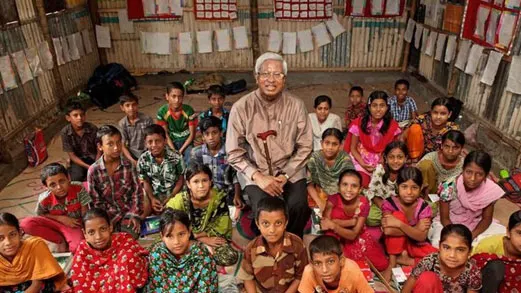
Sir Fazle Hasan Abed, who founded the Bangladesh Rehabilitation Assistance Committee (BRAC) in 1972, describes the strategic and mission-driven underpinnings for the world’s largest NGO. Born in Baniachong, then in British India, Abed studied naval architecture at the University of Glasgow in Britain before qualifying as a management accountant. He acquired British citizenship, but in 1962 returned to (then) East Pakistan to join the oil company Shell, becoming Head of Finance in the local subsidiary. In 1970 he returned to Britain in the face of increasing violence as his country struggled for independence from the rest of Pakistan, and campaigned for European governments to help end the bloodshed.
Returning to the newly independent Bangladesh at the end of 1971, he describes in this interview how he found the country devastated, with few functioning schools, health facilities, and agricultural resources. Recognizing the dire need for a strategic intervention, Abed explains how he was able to use his influence and experience as the former Head of Finance at Shell to negotiate for financial support from Oxfam, based in London, and political support from India. Aware of the role of incentives and the power of rigid social structures, he explains how he founded a Research and Evaluation Department to evaluate the underlying causes of poverty, which revealed the need for a multi-dimensional approach to poverty alleviation using microfinancing techniques to address issues around sanitation, agriculture, education, hygiene, and family planning, among others.
Now having educated over seven million children, BRAC has become one of the world’s most compelling examples of how a non-profit establishment can exercise a transformative impact when rooted in strong business practices.
I’ve never thought that you can do good only through nonprofit activities. You can do good also by doing business.
Download Interview Transcript
Additional Resources
Tarun Khanna and Shreya Ramachandran. "BRAC in 2020." HBS Case 721-416, November 2020. (Revised September 2021.)
Ian Smillie, Freedom From Want: The Remarkable Success Story of BRAC, the Global Grassroots Organization That's Winning the Fight Against Poverty. Kumarian Press, 2009
Naomi Hossain and Anasuya Sengupta, "Thinking Big, Going Global: The Challenge of BRAC’s Global Expansion," IDS Working Paper 339, 2009
Kim Jonker, "In the Black with BRAC,"
Stanford Social Innovation Review, Winter 2009
Md. Akramul Islam, Maria A. May, Faruque Ahmed, Richard A. Cash, and Jalaluddin Ahmed, Making Tuberculosis History: Community-Based Solutions for Millions, foreword by Sir Fazle Hasan Abed. University Press Limited, 2013
Manzoor Ahmad, editor, Education in Bangladesh: Overcoming Hurdles to Equity with Quality, foreword by Sir Fazle Hasan Abed. BRAC University Press, 2011
BRAC in 2014 [HBS Case]
BRAC [HBS Case]
BRAC and Aarong Commercial Brands [HBS Case]
BRAC's Tuberculosis Program: Pioneering DOTS Treatment for TB in Rural Bangladesh [HBS Case]
Tuberculosis in Dhaka: BRAC's Urban TB Program [HBS Case]
Incentives at the Bangladesh Rural Advancement Committee (BRAC) [HBS Background Note]
Sir Fazle Hasan Abed KCMG, Founder & Chairperson
“Delivering the Goods,” PBS Global Health Champions Series: http://http://www.pbs.org/wgbh/rxforsurvival/series/champions/fazle_hasan_abed.html
BRAC blog
Mushtaque Chowdhury and Richard Cash, A Simple Solution: Teaching Millions to Treat Diarrhea at Home. University Press Limited, 1996
George Soros and Fazle Hasan Abed, “The Rule of Law Can Rid the World of Poverty and Injustice,” Financial Times, September 27, 2012
“BRAC in Business: Face Value,” Economist, February 20, 2010
Fazle Hasan Abed interviewed by BBC on Hard Talk, July 8, 2010
“Graduating from Destitution: A Multi-country Study Comes up with a Universal Method to Help the Very Poor,” Economist, August 1, 2015
"The Path through the Fields," The Economist, November 1, 2012
"Is Bigger Better?"
Forbes, May 15, 2008
"Upward Mobility for the World’s Destitute,"
New York Times, May 15, 2015
Video file of this interview available at Baker Library Historical Collections, histcollref+hbs.edu. Harvard ID holders can access the full-length video above.
Creating Emerging Markets Interview with Muhammad Musa
Interview Citation Format
"Interview with Sir Fazle Hasan Abed, interviewed by Tarun Khanna, April 24, 2014, Creating Emerging Markets Project, Baker Library Historical Collections, Harvard Business School, http://www.hbs.edu/creating-emerging-markets/."