Interview Summary
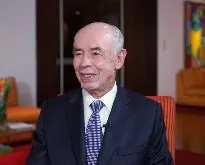
José Alejandro Cortés began his career in 1955, working at the small company founded by his father and uncle in 1939, Seguros Bolívar. Cortés, who had just earned a Master’s degree in actuarial science at the University of Michigan, immediately put his skills to work in a corporate setting. Under a professional manager, he learned about all facets of his family’s business—from accounting and management, to sales, human resources, and company finances. By the 1970s, Cortés was promoted to vice president of the company, in charge of administration and technical matters. Just a few years later, his uncle retired and Cortés became president of Seguros Bolívar. At this point, he explains, he began to reconsider the company’s finances and investments. In the interview, Cortés describes how he began to evaluate the company’s prospects for insurance expansion, and in doing so began to actively engage with the banking and finance industries to maximize the company’s investments. Cortés also reflects on the company’s diversification strategies. He charts the growth of the company from the insurance industry into cement, footwear, and construction. He also talks at length about the group’s decision, in 1972, to move into the financial sector with the creation of Banco Davivienda. In the interview, Cortés discusses the creation of UPAC (Constant Purchasing Power Unit) and the rise of Saving and Housing Corporations in Colombia. This new system, he explains, “hinged on creating a currency—so to speak—that was pegged to the country’s inflation system.” Initially, UPAC was highly successful, with not only the entire financial sector getting involved, but also investors from the construction and housing sectors. Trouble came when the Colombian economy suffered a downturn. In the interview, Cortés describes the difficult economic situation that hit Colombia in 1998-9, and how his company navigated that period. Cortés concludes the interview by reflecting on the broader business environment in Latin America and the company's philosophy on international expansion. He attributes Seguros Bolívar’s long-term success in large part to his practice of paying close attention to how countries in the region manage their economies. In comparison with countries like Peru, Chile, Argentina, and Brazil, he explains, Colombia has managed to prevent the rampant escalation of interest rates—despite experiencing economic fluctuation—thanks to the government’s adequate business management. Cortés also points out that many Latin American countries have experienced political turmoil and frequent regime change in recent decades, and that in comparison, Colombian politics have remained relatively stable. These two factors—comparative political and economic stability—both influenced Cortes to remain in Colombia despite the rise of the guerrilla terrorist movement, FARC, in the 1960s. However, equally important was Cortés’ belief that business leaders are in a position to invest in their countries, and by doing so, inspire confidence in the country’s future. Indeed, in his interview, Cortés explains that “for both the company and for myself as a business leader, the priority is Colombia.”
For both the company and for myself as a business leader, the priority is Colombia. We need to view our institution as an organization that must add value to the entire nation.
Download Interview Transcript
Additional Resources
Interview Citation Format
Interview with Mr. José Alejandro Cortés, interviewed by Andrea Lluch, Bogotá, Colombia, March 2, 2017, Creating Emerging Markets Oral History Collection, Baker Library Special Collections, Harvard Business School.